TryNext AI: The Last Generation That Needed Developers
A Moonshot Blueprint for a World Where Every Human Can Create Software. Programming languages are not fundamental to software creation. Human intent is.
Ranajit Dhar
AI Architect & Builder
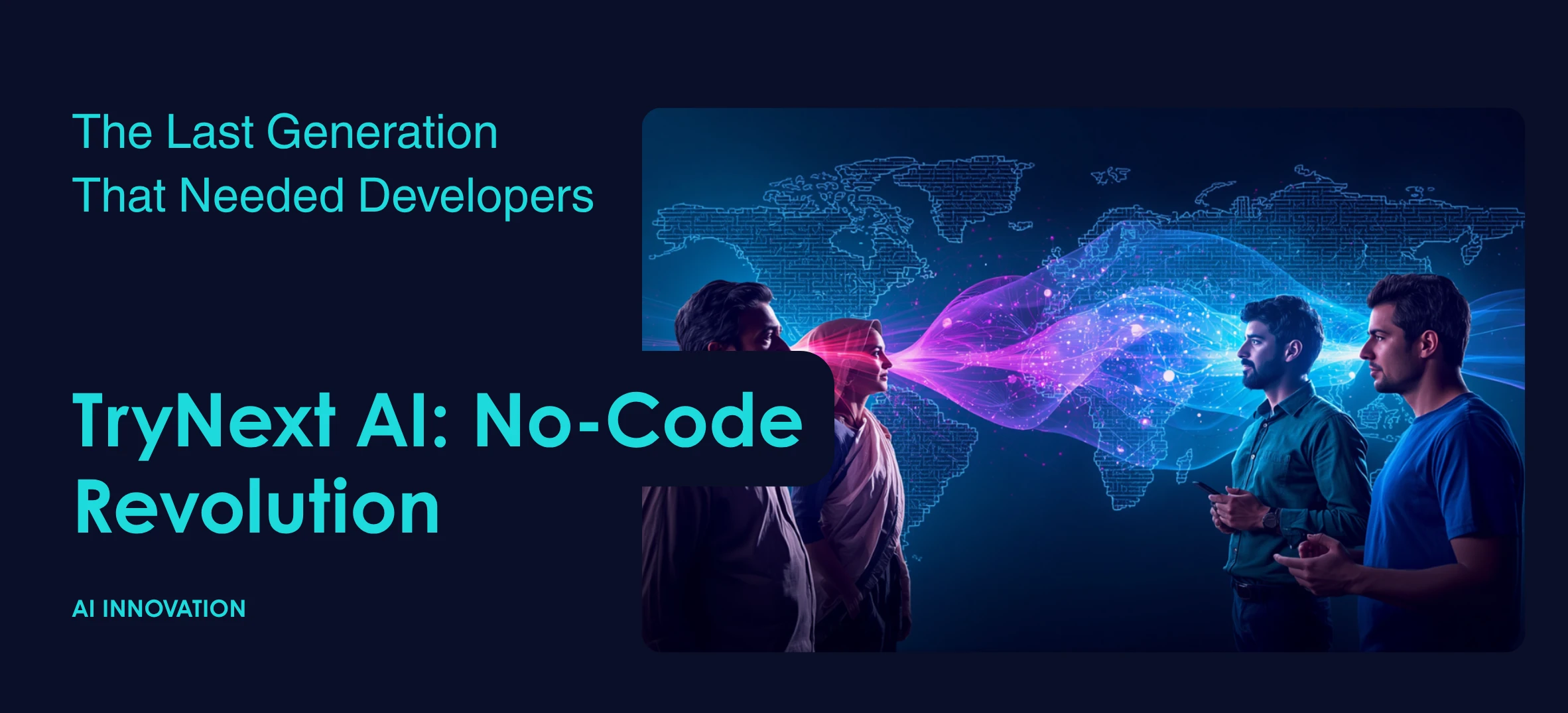
Abstract: For the last seventy years, humanity has accepted a silent assumption: To create software, one must learn programming. Entire industries, universities, labor markets, and innovation ecosystems have been built around this belief. We believe this assumption is wrong.
Programming languages are not fundamental to software creation. Human intent is. TryNext AI proposes a new model for civilization: A future where software is no longer written. It is spoken.
Where a farmer, teacher, student, entrepreneur, or shop owner can transform an idea into a deployed digital product simply by describing it in their native language. Not because they learned to code. But because coding itself became unnecessary. This is not a better development tool. It is an attempt to eliminate software creation as a privilege.
1. The Problem Humanity Misunderstood
Civilizations are not suffering from a lack of ideas. They are suffering from a lack of execution. Today billions of people possess solutions for local problems:
- Teachers understand how education can improve.
- Farmers understand how agriculture can improve.
- Small business owners understand how commerce can improve.
- Communities understand how governance can improve.
Yet most of these ideas never become reality. Not because the ideas are weak. Because software creation remains locked behind three artificial barriers.
- Barrier 1 - Syntax (The 90% Exclusion): Programming languages act as gatekeepers. A person may understand a problem perfectly, yet remain incapable of creating a solution because they cannot speak JavaScript, Python, React, or Next.js. The ability to build software has become confused with the ability to learn syntax.
- Barrier 2 - Language (English-First Domination): The digital economy remains heavily English-centric. Documentation, frameworks, and developer communities are largely inaccessible to billions of people who think, dream, and innovate in other languages. Innovation is filtered through a linguistic bottleneck.
- Barrier 3 - Capital: Building software often requires expensive engineers, agencies, cloud architects, and development teams. As a result, millions of potentially transformative ideas die before the first prototype is ever created. Human imagination is abundant. Execution remains scarce.
2. The First-Principles Insight
Every major technological revolution reduced the distance between intention and execution. Writing removed the need to memorize. Printing removed the need to manually copy. The internet removed the need to physically distribute. Artificial intelligence can remove the need to program.
The software industry assumes that code is fundamental. We reject that assumption. Humans do not naturally think in syntax. Humans think in goals. Stories. Problems. Speech. The ultimate interface for software creation is not a keyboard. It is the human voice. Programming languages are not the destination of software evolution. They are a temporary translation layer. The next era begins when intention becomes executable.
3. The TryNext AI Thesis & Ecosystem
TryNext AI is not a coding assistant. It is not a chatbot. It is not another AI code generator. TryNext AI is an autonomous software factory. A spoken idea enters one side. A deployed application emerges from the other. The user does not learn frameworks. The user does not configure infrastructure. The user does not manage deployments. The user simply describes what they want to exist. The system handles the rest.
Our objective is simple: Transform every human voice into a software architect.
4. Scientific and Technical Foundations
4.1 Swarm Intelligence (The Agentic Loop)
Traditional AI systems rely on a single generation step. This creates hallucinations, inconsistencies, and fragile outputs. TryNext AI employs a multi-agent swarm architecture.
- Manager Agent (Planner): Interprets intent, breaks objectives into architectural blueprints, and creates execution strategies from voice transcripts.
- Coder Agent (Builder & API Hub): Builds Next.js + Tailwind CSS application logic. It autonomously uses the Live Web Clone API to extract UI from reference sites and the Modify Live Logic to inject voice-commanded changes in real-time.
- Evaluator Agent (QA Gatekeeper): Acts as an autonomous quality gate. Reviews generated systems, identifies failures, and forces rewrites before the code ever reaches the Live Sandbox.
4.2 Self-Healing Software (The AI Doctor)
Most software begins decaying immediately after deployment. Bugs accumulate. Dependencies become outdated. Performance degrades. TryNext AI introduces the AI Doctor.
A continuous monitoring layer that observes:
- Frontend performance
- Deployment health
- Agent stability
- Infrastructure integrity
When issues are discovered, the system autonomously proposes fixes and generates corrective pull requests. Software evolves from a static artifact into a living system.
4.3 Survival Architecture (Unbreakable Circuit Breaker)
Dependence on a single AI model creates fragility. TryNext AI employs an autonomous failover circuit ensuring 100% uptime.
| Routing Tier | AI Model Integration | Function & Trigger Logic |
|---|---|---|
| Primary Brain | Gemini 3 Pro | Handles 100% of initial requests. Deep-context architectural reasoning. |
| Failover 1 | Groq Llama 3.3 | Triggered instantly upon rate limits. Ultra-low latency fallback. |
| Survival Brain | HuggingFace Qwen 2.5 | Triggered if network crashes. Open-source survival mode guarantee. |
If one layer fails, another immediately assumes responsibility. The system remains operational even during outages and rate-limit events. Resilience becomes a feature of intelligence itself.
4.4 Zero-Stack Persistence & Deployment
TryNext AI embodies the "Hack the Zero Stack" philosophy. Users bypass complex backend provisioning entirely. Generated apps are pushed from the Interactive Sandbox to a live public URL instantly via Vercel Edge One-Click Deploy. App states, deployment details, and Razorpay-powered micro-transactions are seamlessly persisted in AWS DynamoDB.
5. Why Existing Solutions Are Insufficient
Current AI development tools optimize developers. TryNext AI optimizes humanity. Existing systems still assume:
- The user understands software
- The user understands deployment
- The user understands infrastructure
- The user understands programming
We reject all four assumptions. The goal is not making developers faster. The goal is making developers optional. The difference is profound. One improves productivity. The other expands participation.
6. The Future We Are Creating
The first generation of software democratized access to computers. The second democratized access to information. The third democratized access to publishing. The fourth will democratize creation itself.
In this future:
- A farmer in Bengal launches an agricultural platform through voice.
- A teacher in Kenya creates a personalized education network in Swahili.
- A teenager in a remote village builds a startup before learning a programming language.
- A local community creates emergency response infrastructure without waiting for external technical teams.
Innovation becomes geographically decentralized. Creation becomes universally accessible. The world gains billions of builders.
7. Long-Term Civilizational Roadmap
To turn this global vision into a tangible reality, TryNext AI will evolve through four distinct phases. We are scaling from individual empowerment to building the very digital infrastructure of society. Our visionary roadmap:
- Phase I - Voice to Software: Transform spoken ideas into deployable applications with Zero-Stack capabilities.
- Phase II - TryNext BaaS & Privacy-First Monetization: The AI autonomously provisions isolated AWS DynamoDB instances for users. Users maintain 100% privacy via cryptographically unique "Deployment Hashes" (₹10/month per app) instead of traditional accounts.
- Phase III - Voice to Ecosystems (Native & Design): Expanding the Swarm to compile iOS/Android binaries (.apk/.ipa) via React Native, and Reverse Engineering code into pixel-perfect Figma files. Enable communities to create digital marketplaces directly.
- Phase IV - Voice to Civilization Infrastructure: Healthcare systems. Education systems. Agricultural intelligence networks. Disaster response platforms. Governance tools.
All generated directly from local human intent. At this stage, software becomes a universal capability rather than a specialized profession.
Conclusion
The printing press democratized knowledge. The internet democratized information. Artificial intelligence will democratize creation. When that happens, the most important software company of the future may not emerge from Silicon Valley. It may emerge from a farmer in Bengal. A teacher in Kenya. A student in a village that has never produced a software engineer. Because for the first time in human history, innovation will no longer belong to those who can code. It will belong to those who can imagine.
TryNext AI exists to build that future.
🔍 SEO Keywords
Voice to Software, No-Code AI, Agentic Swarm, AI Software Factory, TryNext AI, Zero-Stack Deployment, AI Democratization, Next.js AI Architecture, Auto-Failover AI, Tech Vision 2026, Ranajit Dhar, AI Engineer Ranajit Dhar.
👨💻 About The Author
Ranajit Dhar
Commerce Graduate → AI Engineer
Creator of ChayRa AI, TryNext AI, YES AI Master Edition, and autonomous agentic ecosystems. Bridging the gap between business logic and highly resilient AI architectures.
Building a future where human intent—not syntax—creates software.
🚀Ready to build AI-first?
I am continuously architecting, building, and documenting production-ready AI ecosystems. If you resonate with this direction and want to scale your ideas, let's initiate a connection.